
November 18, 2026
Monthly Investment Commentary: Market Concentration, AI, and the Case for Diversification

Watch the video above for our perspective on whether growing concentration in technology and AI-linked companies creates unacceptable risk for investors.
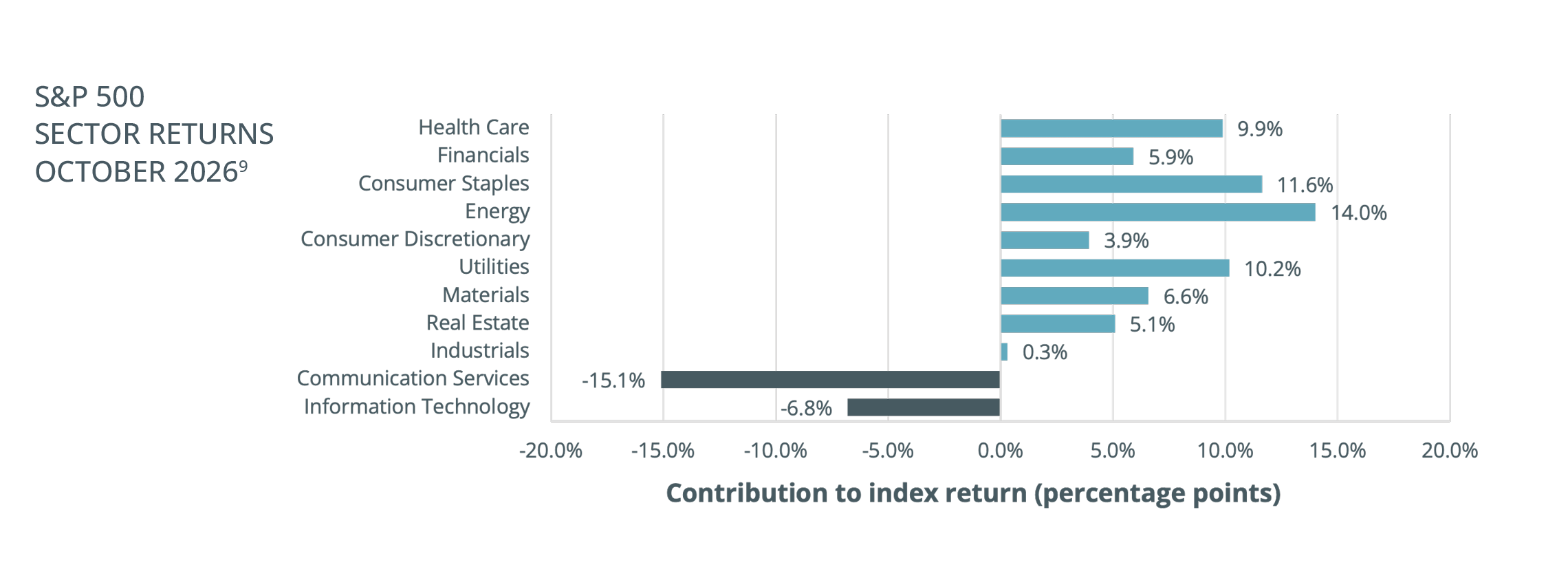
October was a relatively quiet month for broad market indexes, with the S&P 500 delivering a –0.9% return. Energy was the best-performing sector, supported by rising oil prices amid investor concerns about supply disruptions. Following attacks in the Middle East, oil prices ended October at their highest levels since late April.[1]
Beneath the headline return, however, the two AI-heavy sectors fell significantly, with Information Technology down 6.8% and Communication Services down 15.1%. The other nine sectors delivered positive returns, limiting the index’s decline to less than 1%.[2]
October’s performance prompted a key question for investors: Does growing concentration in technology and AI-linked companies create unacceptable risk?
Source: S&P Dow Jones Indices, Index Dashboard: U.S. Total return; data as of October 30, 2026.
Key Takeaways
- AI’s potential doesn’t guarantee investment success. While AI may transform the economy, it’s still uncertain which companies will ultimately generate strong returns.
- History suggests there will be relatively few winners. For instance, many companies behind the automobile disappeared even as the technology transformed the economy.
- The broader stock market works the same way. Research shows fewer than 4% of U.S. stocks accounted for all wealth creation above Treasury bills over the last century.
- Separate enthusiasm for the technology from investment decisions. Believing in AI’s long-term impact doesn’t mean concentrating your portfolio in AI-related companies, and diversification reduces the need to predict which ones will win.
AI’s Market Concentration—Cause for Concern?
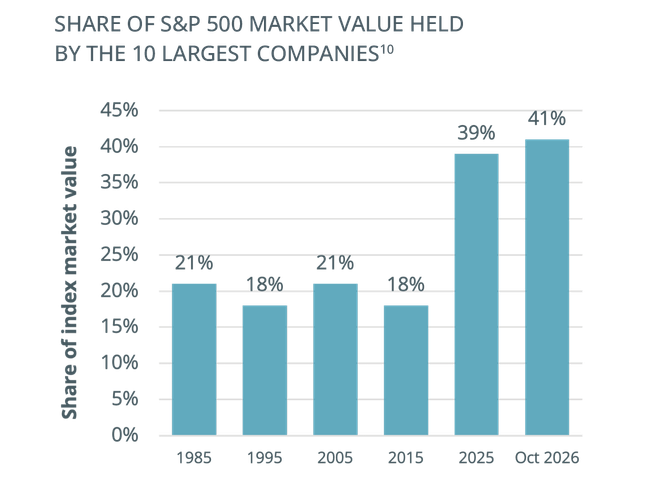
The market has become more concentrated over the last decade. The 10 largest U.S. companies represent 41% of S&P 500 market value. At the start of 1985, 1995, 2005, and 2015, the share ranged from 18% to 21%. All 10 current leaders are technology or AI-linked. AI-related industries represent 53.2% of the S&P 500 index.[3] The natural question is: How worried should investors be about this concentration? Profits have also become more concentrated in the largest firms. The 10 largest companies also represent 36.1% of the S&P 500’s earnings.[4] So the concentration of market capitalization is appropriately reflecting the concentration of fundamentals.
Just because the market is more concentrated now does not mean that we are in a bubble and that stocks are doomed to crash. Historically concentration peaks have not reliably predicted future stock market declines. Goldman Sachs research also found that “even when concentration has been most extreme, the level of index volatility has been largely unaffected”.[5]
Source: J.P. Morgan Asset Management, Guide to the Markets U.S., 4Q 2026, p. 9 (also in the 4Q26 Economic and Market Update). Index weight on the first day of each year; October 2026 for the current year.
What History Shows Us
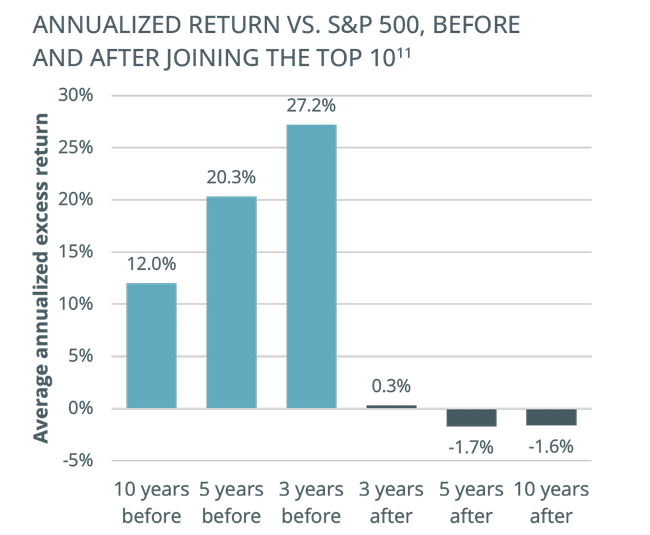
We can look to the past for perspective on what happens as stocks grow larger and more successful. On average, companies outperform the S&P 500 by 27.2% per year in the three years before becoming one of the 10 largest companies. After joining the top 10, the excess return was near zero or negative.[6] We can find other examples throughout U.S. history. In 1908, there were 253 car manufacturers in the U.S. By 1929, there were 44, and three of them contributed about 80% of the industry’s output.[7] The automobile transformed the economy, but most of the companies that set out to build it did not survive. The broader stock market works the same way. Professor Hendrik Bessembinder studied nearly 30,000 U.S. stocks over the last century and found that fewer than 4% of them accounted for all of the market’s wealth creation above Treasury bills.[8] A small number of companies do extraordinarily well, and they are rarely obvious in advance.
Source: Dimensional Fund Advisors, Think Twice About Chasing the Biggest Stocks (June 2026, MKT-62844), using CRSP data.
Lessons for Investors
Diversification is necessary for success. Owning a broadly diversified portfolio is the most reliable way to have exposure to the few enormous winners.
With the high levels of concentration, investing your entire portfolio in the S&P 500 is not sufficient for holding a diversified portfolio. More robust diversification involves including allocations to small-cap stocks, international stocks, bonds, and potentially an allocation to alternatives alongside your allocation to U.S. large-caps. In 2022, the most recent negative year for the stock market, bonds were also negative. Over the last century, bond returns were positive in 21 of the 25 years in which stock returns were negative.[9]
Separate the technology from the investment. Believing AI will change the world does not mean your portfolio needs to be concentrated in the companies driving that transformation.
[1] Oil jumps 2%, settles at 6-month highs on fears of escalation in Iran
[2] Index Dashboard: U.S., October 30, 2026 | S&P Dow Jones Indices
[3] Guide to the Markets U.S., 4Q 2026, pp. 9, 11 and 49 | J.P. Morgan Asset Management
[4] Guide to the Markets U.S., 4Q 2026, p. 8 | J.P. Morgan Asset Management
[5] Exploring Investors’ Concerns About Equity Market Concentration - Goldman Sachs Asset Management
[6] Think Twice About Chasing the Biggest Stocks, June 2026 | Dimensional Fund Advisors
[7] Automobile History | HISTORY
[8] One Hundred Years in the U.S. Stock Markets | Hendrik Bessembinder, SSRN
[9] Guide to the Markets, U.S., 4Q 2026 | J.P. Morgan Asset Management
The information provided is educational and general in nature and is not intended to be, nor should it be construed as, specific investment, tax, or legal advice. Individuals should seek advice from their wealth advisor or other advisors before undertaking actions in response to the matters discussed. No client or prospective should assume the above information serves as the receipt of, or substitute for, personalized individual advice. Because of the many variables involved, an investor should not rely on this report alone. This reflects the opinions of Focus or its representatives, may contain forward-looking statements, and presents information that may change. Nothing contained in this communication may be relied upon as a guarantee, promise, assurance, or representation as to the future. Past performance does not guarantee future results. Market conditions can vary widely over time, and certain market and economic events having a positive impact on performance may not repeat themselves. The charts and accompanying analysis are provided for illustrative purposes only. Investing involves risk, including, but not limited to, loss of principal. Asset allocation and diversification may be used in an effort to manage risk and enhance returns. However, no investment strategy or risk management technique can ensure profitable returns or protect against risk in any market environment. Focus' opinions may change over time due to market conditions and other factors. Numerous representatives of Focus may provide investment philosophies, strategies, or market opinions that vary. The appropriateness of a particular investment or strategy will depend on an investor's individual circumstances and objectives. This should not be considered a recommendation that any particular security, portfolio of securities, transactions, or investment strategy are suitable for any specific person. Any index or benchmark shown or discussed is for comparative purposes to establish market conditions. Index returns are unmanaged and do not reflect the deduction of any fees or expenses and assumes the reinvestment of dividends and other income. You cannot invest directly in an index. This is prepared using third party sources considered to be reliable; however, accuracy or completeness cannot be guaranteed. The information provided will not be updated any time after the date of publication. Please be advised that Focus only shares video and content through our website or other official sources. Services and investment advice are only provided pursuant to an advisory agreement with the client. Focus' Form ADV Part 2A and 2B and Privacy Statement will be provided as required by law and include a description of fees payable for investment advisory services. Services are offered through Focus Partners Wealth, LLC (“Focus”), an SEC registered investment adviser with offices throughout the country. Registration with the SEC does not imply a certain level of skill or training and does not imply that the SEC has endorsed or approved the qualifications of Focus or its representatives. Focus has been part of the Focus Financial Partners partnership since 2011. ©2026 Focus Financial Partners, LLC. All rights reserved. RO-26-6105867
About the Author

Kevin Grogan
Chief Investment Officer of Systematic Strategies