
October 01, 2026
The Backdoor Roth IRA: A High Earner’s Potential Path to Tax-Free Growth

The Roth IRA has become the retirement account of a generation. A decade ago, most families followed the traditional-IRA playbook their parents used—take the tax break now, pay the tax later. For many, that script has flipped.
According to the Investment Company Institute, older savers still lean traditional (46% of Baby Boomers own a traditional IRA versus 24% who own a Roth), but younger generations have reversed the pattern: Millennials now favor Roth (29% vs. 20% traditional), and Gen Z leans even harder that way (25% vs. 12%).
Fidelity’s numbers are more striking still—Gen Z investors steer roughly 95% of their IRA contributions into Roth accounts, compared with 75% for Millennials and 66% for Gen X. Among twenty-somethings, Roth participation nearly tripled between 2016 and 2022.
That enthusiasm tends to run into a wall right about the time it matters most. Once people are earning enough to contribute toward retirement comfortably and confidently, they often find themselves over the income threshold that lets them contribute to a Roth IRA.
In 2026, the ability to contribute directly to a Roth IRA phases out once your income passes $168,000 if you’re single (or $252,000 for a married couple). Cross that line and the front door is locked.
But here’s what most people don’t realize: there’s a back door into the Roth— sanctioned by the IRS and used by high earners every year. Best of all, it’s available to almost anyone with earned income—just a traditional IRA and a few minutes of paperwork.
Why the Roth Is Worth Chasing
You contribute dollars you’ve already paid income tax on. From that point forward, every dollar of growth—dividends, interest, capital gains—is yours to keep. No tax while it grows, and no tax when you pull it out in retirement after age 59½.
Compare that to an ordinary taxable brokerage account: you owe tax on dividends every single year, and you owe tax on your gains when you sell. Over 30 years, that annual tax quietly skims a very large chunk of your returns. A Roth simply doesn’t have that drag.If you’re a high earner in a high-tax state like California, facing the top brackets, sheltering your investments in a Roth means all of that growth compounds completely tax-free.
How the Backdoor Roth IRA Works
The strategy sounds fancy, but it’s simply a two-step move:
- Contribute to a traditional (nondeductible) IRA. There is no income limit to make a nondeductible contribution—anyone with earned income can do it. For 2026, the limit is $7,500 ($8,600 if you’re 50 or older). Because the contribution is nondeductible, it won’t reduce your taxable income. There’s no upfront tax break, just the tax-free growth down the road.
- Convert that traditional IRA to a Roth IRA. There is also no income limit on Roth conversions. Since you already paid tax on the money going in, the conversion itself usually generates little or no tax.
That’s it. Money that couldn’t walk through the front door as a Roth contribution simply steps in through the back as a Roth conversion. Most custodians (Fidelity, Schwab, Vanguard) let you do both steps online in a matter of days.
Watch out for the “Pro-Rate Rule”
This is where most backdoor Roths go sideways. If you already have pre-tax money sitting in any traditional IRA, SEP, or SIMPLE IRA, the IRS won’t let you cleanly convert only your after-tax dollars. Instead, it blends all of your IRA money together and taxes the conversion proportionally. This can turn a “tax-free” move into an unexpected tax bill.
The good news is this rule looks only at IRAs, not at workplace plans. If you have a large pre-tax IRA balance, one common fix is to roll it into your current employer’s 401(k) (if the plan accepts it) before doing the backdoor Roth. This leaves your IRA “empty” of pre-tax money. It’s worth a conversation before you pull the trigger.
Use CaseExample: Meet Elena
Elena is a 30-year-old physician. She earns about $300,000 a year—comfortably over the Roth income limit for a single filer. She can’t contribute directly, so she’s deciding what to do with an extra $7,000 a year she wants to invest for the long haul.
She has two choices: a taxable brokerage account or the backdoor Roth IRA. To keep the math simple, let’s follow that $7,000-per-year account, invested at a 7% annual return from age 30 to age 60—30 years of steady saving. Both receive the same $210,000 in total contributions.
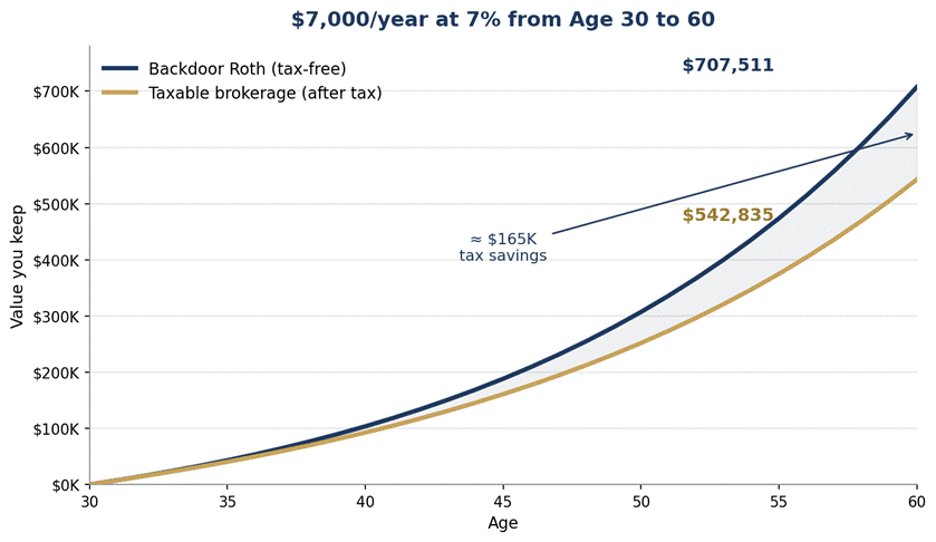
For illustrative purposes only. This is designed to demonstrate the impact of different types of retirement accounts and tax impacts. Assumed in after tax calculations a combined rate near 33%: top federal rate 20%, net investment income tax 3.8%, and California income tax ~9.3%.[DE1]
In the Roth, the account grows to about $707,500—and every penny is hers, tax-free.
In the taxable brokerage account, the money grows to that same $707,500 on paper, but selling triggers capital-gains tax on the ~$497,500 of growth. As a high earner in California, her long-term gains stack the top federal rate (20%), the 3.8% net investment income tax, and California income tax (~9.3% in her bracket)—a combined rate near 33%. That’s roughly $164,700 in tax, leaving about $542,800.
At age 60 ($7,000/yr for 30 years at 7%) | Taxable Brokerage | Backdoor Roth IRA |
Total contributed | $210,000 | $210,000 |
Account value (pre-tax) | ~$707,500 | ~$707,500 |
Tax owed at the finish line | ~$164,700 | $0 |
What she actually keeps | ~$542,800 | ~$707,500 |
|
That’s roughly $165,000 more in her pocket from the same contributions, the same investments, and the same rate of return. The only variable that changed was the tax wrapper.
Final Backdoor Roth Considerations
Mind the pro-rata rule: If you hold other pre-tax IRA money, clear it out first if you can.
- Convert promptly: This helps avoid being taxed on growth between contribution and conversion.
- Keep the two steps clean: Contribute to the traditional IRA, then convert; don’t invest the money in between.
- File Form 8606: This documents nondeductible contributions and keeps the IRS from taxing you twice.
The Bottom Line
Younger savers have embraced the Roth for good reason—decades of tax-free growth are hard to beat. The frustrating part is that just as your career takes off, the income limits can shut the front door. The backdoor Roth is the answer: it lets high earners keep capturing that tax-free growth instead of watching it get quietly eroded by taxes in a brokerage account.
Because it lives in an ordinary IRA rather than an employer plan, it’s a strategy that’s within reach for nearly any high earner with earned income. The mechanics are simple, but the details—especially the pro-rata rule and the timing—are where people trip up. Done right, it turns a few minutes of paperwork into decades of tax-free compounding.
If you’re wondering whether the backdoor Roth makes sense for your situation, or how to sidestep the pro-rata trap, we’d love to have a conversation. Schedule a meeting with us now
Category
InvestingThis is provided for informational purposes only. The content does not purport to present a complete picture, but Focus believes the information is representative of issues and needs facing some clients. The fictional scenario and examples described are hypothetical in nature and are provided to demonstrate various questions clients may encounter. The scenario is not intended to predict future outcomes. This should not be construed as specific investment, tax, or legal advice. Individuals should seek advice from their wealth advisor or other advisors before undertaking actions in response to the matters discussed. No client or prospective should assume the above information serves as the receipt of, or substitute for, personalized individual advice. This represents the opinions of Focus, may contain forward-looking statements, and presents information that may change due to market conditions or other factors. Nothing contained in this content may be relied upon as a guarantee, promise, assurance, or representation as to the future. Investing involves risk, including, but not limited to, loss of principal. Numerous representatives of Focus may provide investment philosophies, strategies, or market opinions that vary. The appropriateness of a particular investment or strategy will depend on an investor's individual circumstances and objectives.
This is prepared using third party sources considered to be reliable; however, accuracy or completeness cannot be guaranteed. The information provided will not be updated any time after the date of publication. Because of the many variables involved, an investor should not rely on this report alone. All tax laws and regulations discussed are subject to change. Services are offered through Focus Partners Wealth, LLC (“Focus”), an SEC registered investment adviser with offices throughout the country. Registration with the SEC does not imply a certain level of skill or training and does not imply that the SEC has endorsed or approved the qualifications of Focus or its representatives. Focus has been part of the Focus Financial Partners partnership since 2011. ©2026 Focus Financial Partners, LLC. All rights reserved. RO-26-5933129


