
August 24, 2026
Monthly Investment Commentary: August 2026

What is a “Bubble”—And How Does It Pertain to AI?
In economic terms, a “bubble” occurs when prices for something like stocks or technology go up quickly, often beyond their true value, then ultimately crash (or burst) when investors recognize prices aren’t in line with value and attempt to quickly sell. The term itself is somewhat fraught, as it is typically a word we tend to apply only after prices have fallen. For instance, in 1996, the internet looked expensive. An investor who sold on that view missed four more years of gains. In 1999, the internet also looked expensive, and that time the concern proved warranted. Same signal, very different outcome. The label is obvious only in the rearview mirror.
Whether artificial intelligence is a bubble is the question we’re hearing most often from clients recently and unfortunately, no one knows for sure. However, that is not a reason to stop asking questions; it is a reason to ask better ones. Three that are worth your time:
- What do I actually own today?
- How is the AI buildout being paid for?
- What does this mean for my portfolio?
What Do You Actually Own?
The most concrete thing you can know right now is the composition of your own portfolio. As of August 10, 2026, the 10 largest companies in the S&P 500 accounted for 38.2% of the index. For most of the period from 1990 through 2015, that figure sat between 18% and 23%. It reached a record 40.7% at the end of 2025 before a pullback this year. At the end of 2000, the 10 largest companies represented roughly 23% of the index.
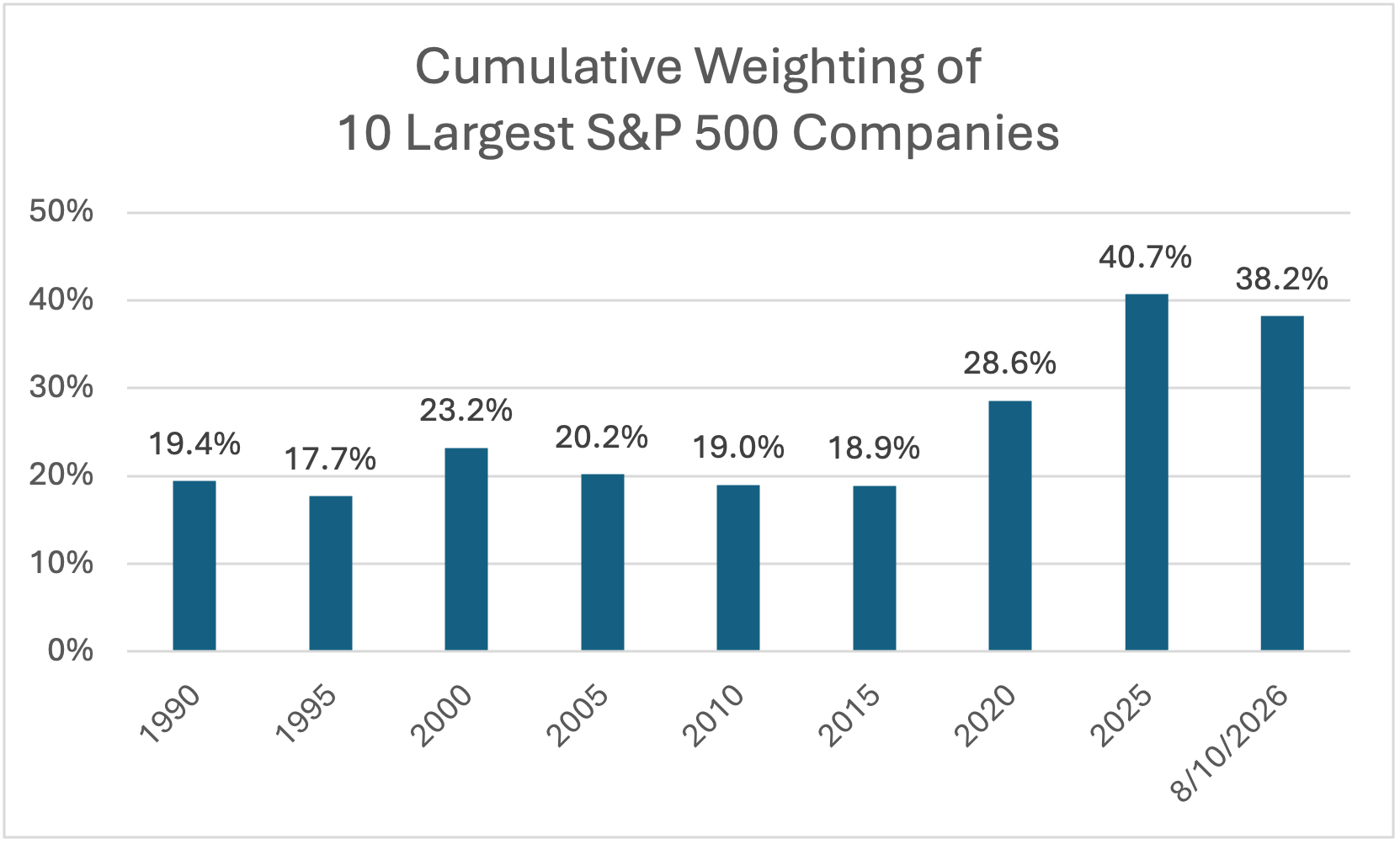
Source: RBC Wealth Management, FactSet; data reflects year-end weighting for each year
This is not an argument against index investing. Those weightings reflect the collective judgment of every market participant about where value sits today. It is simply a statement of fact about exposure. An investor who has held the same broad U.S. index fund for a decade owns something quite different today than what they bought, and a much larger share of the outcome now rests on a handful of companies pursuing a related set of opportunities.
How is the AI Buildout Being Paid For?
The strongest argument against the bubble label is that unlike many of the companies at the center of the late 1990s, today’s leaders are enormously profitable. They sell products that hundreds of millions of people and businesses use every day, they generate substantial revenue from them, and they entered this investment cycle with very strong balance sheets. That is a meaningfully different starting point.
The financial structure supporting the buildout, however, is changing. Capital expenditures at the five largest cloud and artificial intelligence infrastructure companies are expected to exceed $690 billion in 2026, with consensus estimates for 2027 approaching $870 billion. At the start of the year, the 2026 estimate was close to $480 billion. PIMCO calculates that this spending will absorb roughly 94% of these companies’ operating cash flows in 2026 and 2027, compared with about 40% in 2023.
When internally generated cash no longer covers the bill, the balance comes from debt, leases, and equity issuance. Incremental annual debt rose from 9% of capital expenditures in 2024 to 32% over the 12 months ending June 2026, and Alphabet priced an $84.75 billion equity offering in June. The combined weight of Meta, Alphabet, Amazon, and Oracle in the Bloomberg U.S. Corporate Investment Grade nearly doubled over the year ending April 1, 2026, rising from 2.2% to 4.1%. Moody’s Ratings, reviewing six of the largest builders in July, placed their combined direct debt near $460 billion and their total data center lease commitments at roughly $1.2 trillion, of which more than $820 billion relates to leases that have not yet commenced and therefore do not yet appear on balance sheets.
None of this is a forecast of trouble. Borrowing to finance an asset that is expected to generate a return is ordinary corporate finance, and these remain exceptionally strong companies. It does change the shape of the risk, as exposure to the AI buildout is no longer confined to the equity side of the portfolio. It is arriving in the investment grade corporate bond market.
What Does This Mean for You?
No single data point is meaningful enough to drive a change to your portfolio. It is true that U.S. equities have high valuations relative to history, and while valuations have a relationship with forward-looking returns over horizons of a decade or more, they have very little predictive power over one or two years.
Concentration by itself is not a signal either. Markets have been concentrated before and gone on to deliver strong returns and concentrated before and gone on to deliver poor returns. What concentration does reliably tell you is how much of your portfolio’s performance now depends on a small number of outcomes. That is a statement about the range of possibilities, not about direction.
A technology can be genuinely transformative and the price paid for it can still be too high. Those are separate questions, and history offers several examples where the answer to both was yes. Railroads and the internet each reshaped the economy, and each produced painful stretches for the investors who financed the buildout.
If AI delivers what its advocates expect, a diversified portfolio participates in that outcome. It owns the eventual winners without having had to identify them in advance, and it owns more of them as their success becomes evident and the market assigns them a larger share.
If the return on this spending disappoints, a portfolio diversified across company size, across value and growth, across sectors, and outside the United States will feel it without depending on it. Diversifying away from the ten largest U.S. companies is not a bet against AI. It is an acknowledgment that nobody yet knows which firms will capture the value created, and that the answer has historically surprised nearly everyone.
The same principle applies on the fixed income side of the portfolio, which is a newer consideration. Diversification across security types, issuers, sectors, and maturities is always a prudent strategy, but especially considering the omnipresent AI risks.
We do not know whether this is a bubble, and we would be cautious with anyone who claims otherwise. What we can say is the more useful question is not whether artificial intelligence is overvalued. It is whether your portfolio is built to meet your goals in either case.
Category
InvestingContent Topics
This is provided for informational purposes only. The information provided herein does not purport to present a complete picture, but Focus believes the information is representative of issues and needs facing some clients. This should not be construed as specific investment, tax, or legal advice. Individuals should seek advice from their wealth advisor or other advisors before undertaking actions in response to the matters discussed. No client or prospective should assume the above information serves as the receipt of, or substitute for, personalized individual advice. This represents the opinions of Focus, may contain forward-looking statements, and presents information that may change due to market conditions or other factors. Nothing contained in this content may be relied upon as a guarantee, promise, assurance, or representation as to the future. Investing involves risk, including, but not limited to, loss of principal. Asset allocation and diversification may be used in an effort to manage risk and enhance returns. However, no investment strategy or risk management technique can ensure profitable returns or protect against risk in any market environment. Numerous representatives of Focus may provide investment philosophies, strategies, or market opinions that vary. The appropriateness of a particular investment or strategy will depend on an investor’s individual circumstances and objectives. Because of the many variables involved, an investor should not rely on this report alone. This is prepared using third party sources considered to be reliable; however, accuracy or completeness cannot be guaranteed. The information provided will not be updated any time after the date of publication. Any index or benchmark shown or discussed is for comparative purposes to establish market conditions. Index returns are unmanaged and do not reflect the deduction of any fees or expenses and assumes the reinvestment of dividends and other income. You cannot invest directly in an index. Please be advised that Focus only shares video and content through our website or other official sources. Services and investment advice are only provided pursuant to an advisory agreement with the client. Focus’ Form ADV Part 2A and 2B and Privacy Statement will be provided as required by law and include a description of fees payable for investment advisory services. Services are offered through Focus Partners, LLC (“Focus”), an SEC registered investment adviser with offices throughout the country. Registration with the SEC does not imply a certain level of skill or training and does not imply that the SEC has endorsed or approved the qualifications of Focus or its representatives. Focus has been part of the Focus Financial Partners partnership since 2011. ©2026 Focus Financial Partners, LLC. All rights reserved. RO-26-5832024


